
iPhone Screenshots

Description
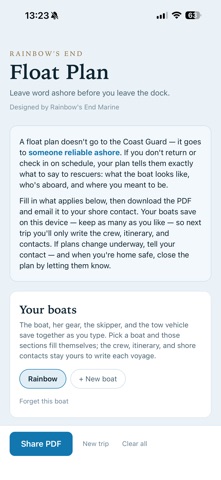
A float plan is the simplest safety gear you own: a page left with someone reliable ashore, so that if you don’t come home, they know what to tell rescuers. This app fills one out with you, remembers your boat, and hands you a PDF made to be emailed.
It follows the official Coast Guard Auxiliary float plan — the whole inventory a search would ask for — grouped the way a sailor actually thinks, with a line in each section on why it matters.
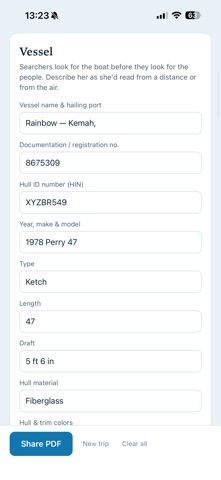
YOUR BOATS — Enter a vessel once and she is saved: name and hailing port, registration and hull ID, length, draft, hull material, her colors, the features someone would spot from the air, and what drives her. Keep as many boats as you sail — the cruiser, the skiff, a friend’s boat — and switch between them with a tap. Her sections fill themselves; only the voyage is left to write.
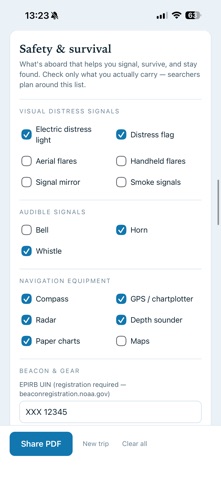
WHAT SHE CARRIES — Radios and the channels you actually monitor, call sign and MMSI, cell and satellite numbers. Visual and audible distress signals, navigation equipment, EPIRB and PLB registration numbers, raft, exposure suits, dewatering, the anchor and how much rode she has, and the days of food and water aboard. Searchers plan around this list.
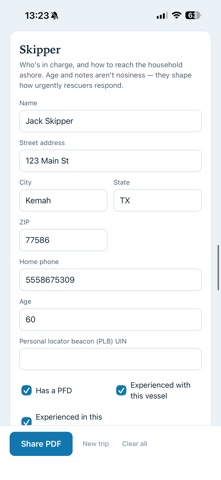
WHO IS ABOARD — The skipper, with the household ashore and experience on this boat and in these waters. Then every crew member and passenger: name, age, phone, life jacket, beacon number, and a note for medical needs or anything a searcher should know. If you trailer in, the tow vehicle and where it is parked — often the first thing found.
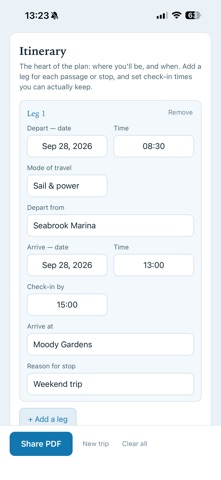
WHERE YOU ARE BOUND — The itinerary, leg by leg: depart from here at this hour, arrive there by then, the reason for the stop, and a check-in time you can actually keep. Then the part that turns a form into a plan — your shore contacts in calling order, the rescue authority that answers marine emergencies where you are going, and the single deadline after which you are overdue.
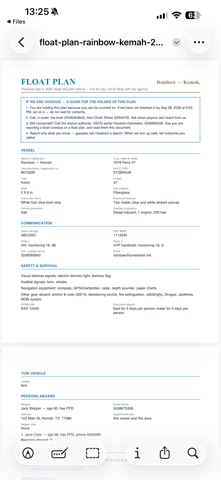
THE PDF — One tap builds the plan and opens the share sheet; Mail is two taps from a filled form. It opens with a guide addressed to whoever holds it: call the boat, then each contact in order, then the rescue authority — with your actual numbers already filled in — and report only what you know, because guesses misdirect a search. Nobody has to read a form while worried. Empty fields simply stay off the page.
Between voyages, New trip clears the itinerary, dates, and notes, and keeps everything else.
Works fully offline. No account, no server, no tracking, and no location or GPS — every place in your plan is a place you typed. Nothing leaves your device unless you send it yourself.
A float plan is never filed with the Coast Guard. It goes to a person ashore who will act if you do not come home, and it is closed by telling them you are safe.