
iPhone Screenshots



Description
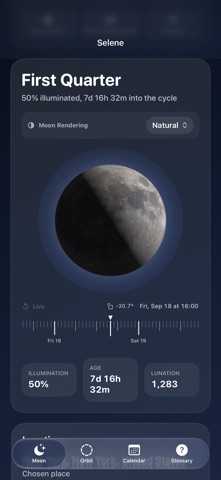
Selene is a calm lunar reference for iPhone and iPad. Check the current phase, illumination, age, lunation, distance, and the next major event at a glance.
Siri and Shortcuts bring the Moon into your day: get phase and illumination for a chosen date, find the next moonrise, moonset, full moon or new moon, and check current altitude and direction relative to the geometric horizon. Add Selene actions to your own shortcuts, ask Siri to run them by name and reuse numbers and dates in later actions. Astronomical calculations run locally; the reported position does not account for weather or obstacles.
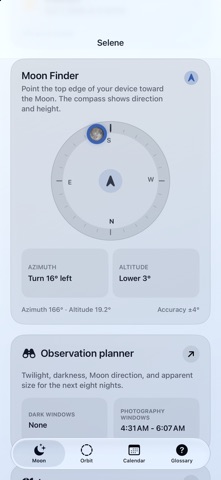
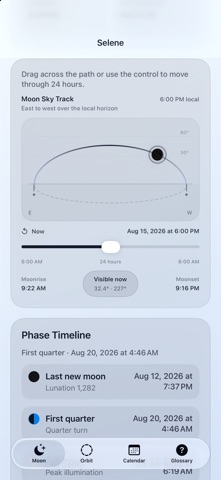
Choose any place to see local moonrise, moonset, and visibility, then browse a clean moon calendar built for quiet observation. Widgets keep the moon close without clutter.
New in Selene, Orbit turns the Sun, Earth, and Moon into a precise spatial model synchronized with the timeline, making phases, orientation, and eclipse geometry easier to understand.
Scale: True proportions for Sun, Earth, and Moon. The Sun is 109 Earth diameters wide and about 389 lunar distances away, so a single true-scale drawing would hide the Moon.
Classic: Uses the previous Selene moon rendering.
Natural: NASA/LROC imagery with natural surface colors and lighting.
Contrast: Shows the lunar surface in high-contrast monochrome.
Relief: NASA/LOLA elevation colors and shaded terrain. Colors represent height, not true surface colors.
Coordinates: Adds a subtle latitude and longitude grid.
Changes only the lunar surface rendering; phase, location, visibility, and calendar data stay unchanged.
Your chosen iPhone Moon style syncs to Apple Watch and remains available offline after syncing.
One purchase unlocks Selene on iPhone, iPad, Mac and Apple Watch. No subscription and no ads.
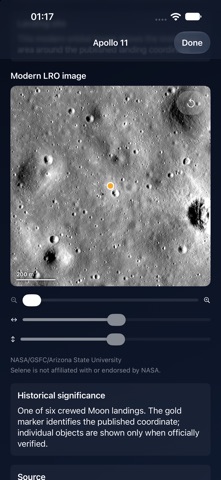
Explore all six crewed Apollo landing sites in verified modern LRO images. This modern orbital image shows the immediate area around the published landing coordinate. The image was cropped, scaled and compressed without adding, removing or moving surface details.
Current lunar phase, illumination, distance, and local visibility. Short explanations of the astronomical terms used in Selene.