
iPhone Screenshots


Description
Pipe Branch Layout Calculator is a powerful and professional engineering tool developed for generating accurate flat pattern and fabrication layouts for pipes, shells, branches, cones, and miter bends used in industrial fabrication.
The app is designed to simplify complex layout calculations and eliminate manual errors during fabrication. It supports both millimeter (mm) and inch units, making it suitable for international fabrication standards and workshops.
This calculator provides precise flat plate dimensions, layout lengths, widths, and detailed part values, allowing fabricators to directly transfer layouts onto plates or pipes with confidence.
Why Use Pipe Branch Layout Calculator
Reduces fabrication time and calculation errors
Eliminates complex manual calculations
Produces fabrication-ready flat patterns
Ideal for workshop, site, and design office use
No internet connection required
Fast, lightweight, and highly accurate
No Irritating Ads.
Use Both mm and Inches Units for Input and Output.
All Branch Pipe Layouts in one place.
The app is based on industry-proven pipe branch cutting and development formulas and recommends mean value–based layout methods for better accuracy during marking and cutting.
Supported Fabrication & Flat Pattern Tools
1. Pipe / Shell Flat Pattern Layout
Calculate flat development for plain pipes or shells with a selectable number of parts and levels.
Inputs: Diameter, Height
Output: Flat plate width and length
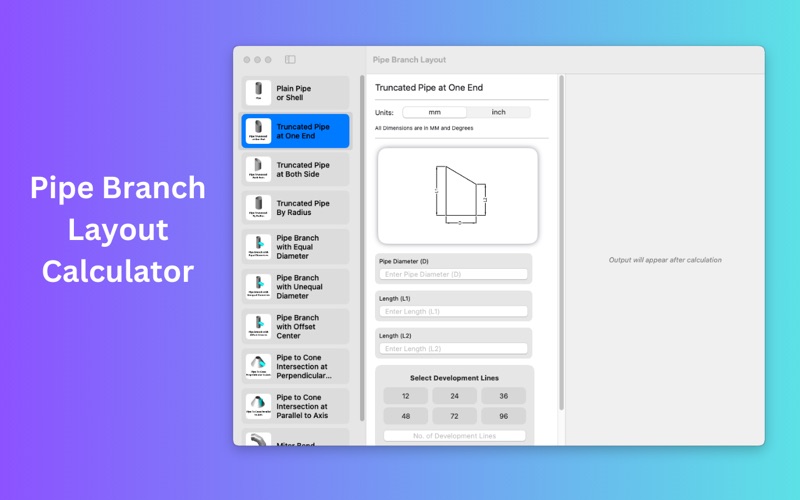
2. Pipe or Cylinder Truncated at Top Angle
Calculate flat patterns for pipes truncated at an angle on the top side.
Inputs: Pipe diameter, Large side height, Small side height
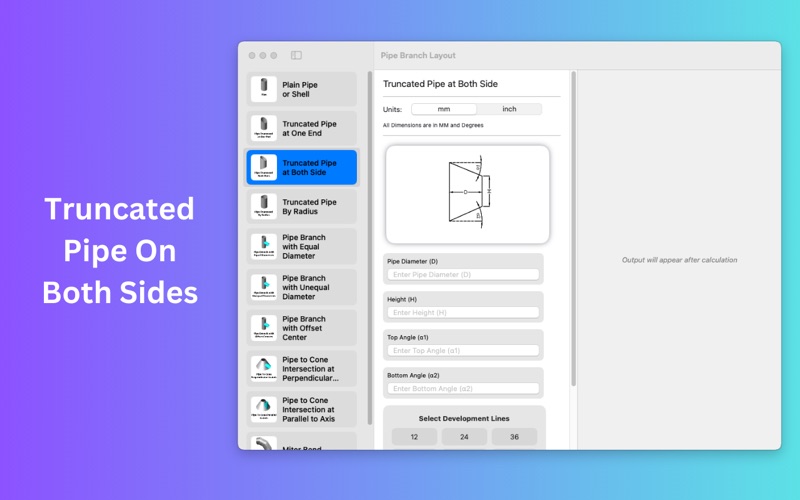
3. Pipe or Cylinder Truncated at Top & Bottom Angles
Flat pattern calculation for pipes truncated at different angles on both ends.
Inputs: Diameter, Center height, Top angle, Bottom angle
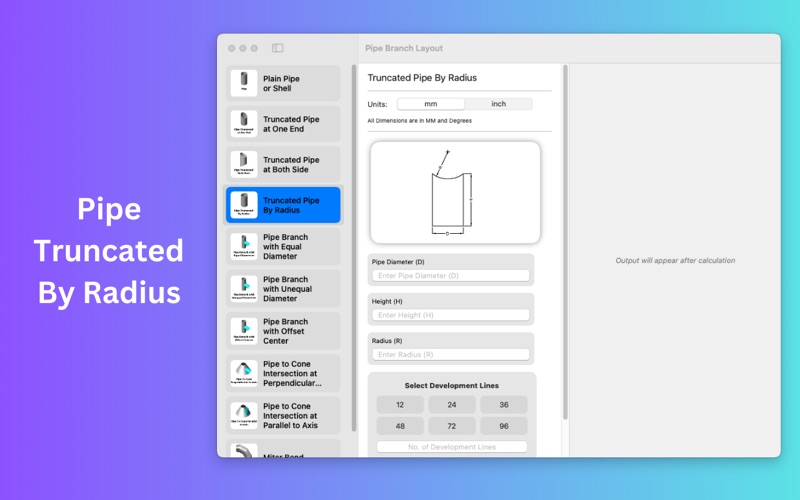
4. Pipe or Cylinder Truncated with Radius at Top
Used for layouts where the pipe or shell is cut with a radius at the top.
Inputs: Diameter, Center height, Top radius
5. Pipe-to-Pipe or Cylinder-to-Cylinder Intersection (90°, Equal Diameter)
Branch layout formed by two pipes intersecting at 90° with equal diameters.
Inputs: Pipe diameter, Branch center distance
6. Pipe-to-Pipe or Cylinder-to-Cylinder Intersection (90°, Unequal Diameter / Offset)
Used for unequal diameter branches or offset branch connections.
Inputs: Main pipe diameter, Branch pipe diameter, Center distance, Offset distance
7. Pipe / Nozzle to Cone Intersection (90°)
Flat pattern layout for pipe or nozzle intersecting a cone at 90°.
Inputs:
Cone large diameter, Cone small diameter, Cone height,
Pipe / Nozzle diameter, Pipe height from cone base, Center distance
8. Pipe / Nozzle to Cone Intersection (Parallel Axis)
Used when pipe or nozzle intersects a cone with parallel axis alignment.
Inputs: Same as above
9. Miter Bend Layout Tool
Calculate accurate flat patterns for miter bends commonly used in piping systems.
This tool helps determine segment angles and development dimensions for smooth directional changes in pipelines.
Inputs: Pipe diameter, Bend Radius, Bend angle, Number of miter pieces
Output: Flat pattern dimensions for each miter segment
Detailed Layout Output
Flat plate width and length
24-part layout values for precise marking
Mean value–based calculations for improved accuracy
Fabrication-ready numerical data
Who Can Use This App
Pipe Branch Layout Calculator is widely used in the fabrication of piping spools, pressure vessels, pipelines, tanks, and other process equipment.
Recommended for:
Piping Engineers
Fabrication Engineers
Pipe Fitters & Welders
Production Engineers
Quality & Inspection Engineers
Costing & Estimation Engineers
AutoCAD & Drafting Engineers
Mechanical & Design Engineers
This Mac app delivers accurate, reliable, and professional pipe layout calculations, helping fabrication teams work faster, smarter, and with higher precision—directly from their desktop.