Along hidden lines to complete challenges. Rate drawings with 1 to 3 stars. Unlock cute animals and funny objects based on performance. Retry drawings if they are not good enough.
The app offers eight calculators, including tools for specific productivity and transfection experiments. It simplifies lab tasks by calculating necessary reagent amounts and providing next step recommendations.
Explore mathematical concepts through interactive simulations. Adjust parameters via device tilt to control strange attractors, chemical oscillators, and 3-body star systems. Create and manipulate fractals in real time.
Create scatterplots and fit simple or multiple linear, logistic, or exponential models. Display standard errors, confidence intervals, and P-values for model parameters. Include categorical predictors and two-way interactions.
View a real-time map based on your location. Identify stars, planets, constellations, and the moon. Adjust the view by moving your device. Zoom in for detailed celestial objects. Share observations or save screenshots of the sky.
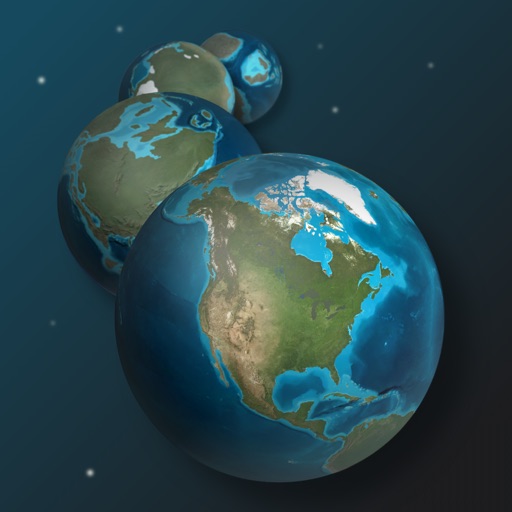
Explore Earth's geological history by visualizing continents, oceans, and climate changes over billions of years. Adjust time scales to view past landscapes, track sea level shifts, and observe planetary transformations.
Calculate percentages, find the total, or determine the part. Input two values to automatically compute the third. View detailed step-by-step calculations. Share the complete solution with others.
Program camera mounts for astrophotography and time-lapse photography. Adjust settings for exposure and interval. Perform polar alignment using the polar scope. Sync with Sky-Watcher equatorial mounts. View camera status and control shutter remotely.
The app performs data analysis including summary statistics, various plots, and probability calculations. It supports data import from CSV files and Dropbox, handling stacked and unstacked data.
Through structured lessons for beginners and intermediate players. Study rules and strategies to understand the game thoroughly. Use augmented reality mode to visualize moves and improve gameplay.
Learn through interactive flashcards that adapt to your knowledge level. Swipe through cards, skip manual tagging, and focus on progress. Set learning sessions and review words based on performance. Track progress over time with detailed insights.
Allows users to identify celestial objects by pointing their device at the sky. It uses GPS and device sensors to display stars, planets, constellations, comets, and meteor showers.
Explore the universe from the Big Bang to microscopic structures using interactive VR simulations. Navigate through cosmic scales, view NASA datasets, and examine medical imaging and 3D microscopy.