The app records every calculation step, allowing users to modify any step and recalculate without re-entering data. It functions like a printing calculator with a paper tape history for clarity and ease of use.
Calculate primary and secondary full-load currents based on ratings and voltages. Determine turns ratio and type. Input phase type and voltage values to obtain current outputs and ratio calculations.
Access steel specifications including wall thickness and mass measurements in inches, millimeters, pounds, and kilograms. Convert units between feet, meters, pounds, and metric tonnes. Compare costs and view charts from ASME B36.
Helps estimate materials for various shapes. Users input dimensions to calculate volume and quantity. Features include slab, column, and post calculations. Saves results for future reference.
Calculate , perimeter, , and weight for 170+ geometric shapes. Input measurements or use calculation methods for missing values. Select materials like metal, wood, or liquid to determine weight. Search shapes by typing or swipe through categories.
Perform arithmetic calculations with 12 digits. Calculate tax, percentages, and cost, selling price, and gross margin. Use memory functions, square root, and sign change. Track grand total.
Allows users to save formulas for repeated use. Enter variables to recalculate results without rewriting formulas. Supports trigonometric functions, logarithms, factorials, and permutations. View saved formulas and variables for easy access.
The app provides 2D vector drawing and design for iPad and iPhone. It offers unique offset controls for precise finger-based editing and supports iCloud synchronization with its Mac version.
Calculate with formulas and swipe between calculators
A calculator displays formulas during calculations. Users can switch between seven calculators by swiping. Perform basic and advanced math operations. Store and reuse calculation history. Adjust display settings for different modes.
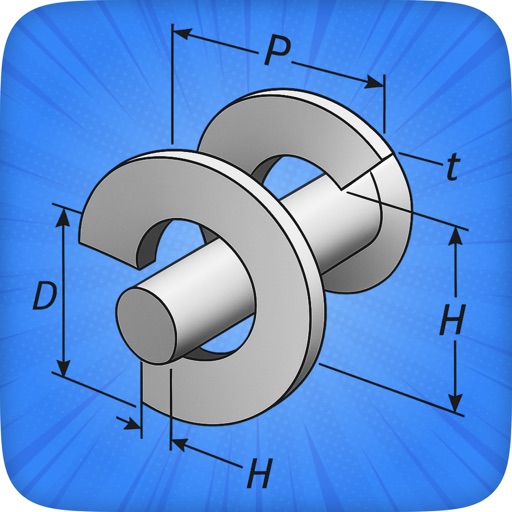
Metallic expansion joints by selecting internal diameter, convolution height, ply thickness, pitch, and number of plies. Set pressure and temperature. Choose materials and input axial, lateral, and angular movements.
Control and monitor the process using an e8 machine. Display current, remaining time, and progress as a bar graph. Receive alerts via hint or vibration for weld completion or errors. Show error details and instructions when issues occur.